svgenerator.
i needed svg files for my sites and the options were either digging through free repos and never finding what i wanted, or paying for stock vectors that still needed editing. so i built a tool that takes a text prompt and gives you a clean svg. you describe what you want, pick a style, it generates it. there's also an image to svg converter. it's at svgenerator.org.
this project started due to my need for a way to make svgs for my projects to use as logos or just designs. i couldnt find any libraries that had exactly what i wanted, so i built a website that uses ai in order to make it easier for me, and in the process i learnt a bit about marketing, ux and logging. its live at svgenerator.org.
the site itself is built in nextjs, with mostly custom components and logging stored in neon postgres. i use clerk for user signin and stripe set up for payments, as it was much easier and faster than making my own solution, and is monetised with monthly subscriptions and pay-per-image payment methods.
as i was building, i found that there was quite a lot of saturation in the market already for just generic svg generators, so i looked for some areas where i could differentiate myself slightly and i found a community of people who use laser cutters and cricut machines (these cut things like paper and vinyl stickers similar to a laser cutter but more friendly for non technical users). the latter community specifically seemed like they’d be an ideal community to try to target, as they had frequent complains about designs not cutting properly, and they werent technical enough to understand why that was. i learned that the reason was that the svgs were simply no good, things like duplicate lines caused burning and ripping in materials, so this gave me an idea which was to sanitise svgs for these people to let them upload a picture of a design they want and receive back a perfectly cuttable design.
to verify, i used claude code to look at google search traffic regarding topics such as ‘bad cuts cricut’ and ‘fix svg for cricut design space’, i found that there was a sizable volume for them (over 10,000/mo) and 0 results coming up other than reddit posts. nobody had made something for this.
this led me to research some ways of marketing and validating the demand using claude, i asked it to research examples of similar situations people have been in and found pieter level’s approach which was validating demand BEFORE producing the final product, so i determined that some social media presence was worth getting, so i made a pinterest account and started posting on it as well as joining some facebook groups and reddit groups, getting some posts out regarding the similar problem and offering a solution (though the groups often ended up deleting the posts).
similar to pieter levels, i created a page for the differentiated app that looks like a working product, but is actually a waitlist that you sign up for, but relying on sunk cost fallacy to make the user more likely to enter their email. you can upload an svg, press fix and have an illusion of something being done, only to be stopped at the point you need to enter your email to receive the file back. this gives the customer a real ux, but then tells them at the end to sign up for the waitlist.
this method is particularly interesting, because it prevents you allocating your time somewhere where it isn’t useful, and customers are more likely to sign up because they believe it to be a working app until the last point, and it has been proven successful by some devs.
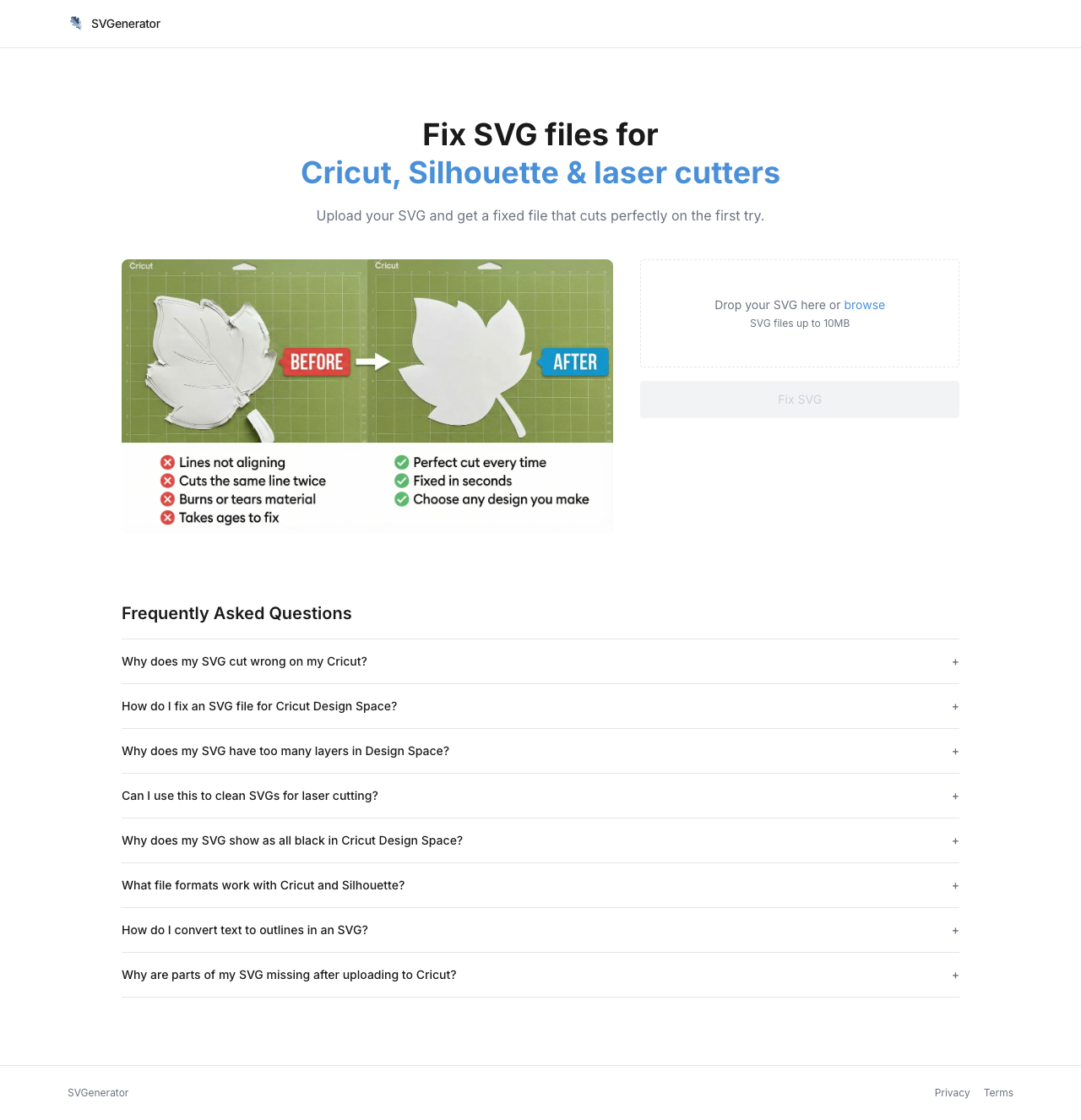
it lives at waitlist.svgenerator.org and logs the user data, such as device, so i can decide where to go next.
additionally, i analysed competitor sites against search terms and found terms that none of them were including. those terms i put in the faq, page copy and metadata, this way if someone searches for a phrase that no competitor has on it, my site will come up at the top for them.
while the waitlist builds and i collect data, i’m also building the same app for the ios app store to see if it could get more traffic, and if i get some good signal for the differentiated app with the svg cleansing ill build it, otherwise i will just leave it.